
Modernization
Why Companies Migrate Software Projects: 12 Real Business Triggers
The real reasons organizations migrate systems—cost, risk, talent, compliance, product speed—and how to tell a necessary migration from a resume-driven rewrite.
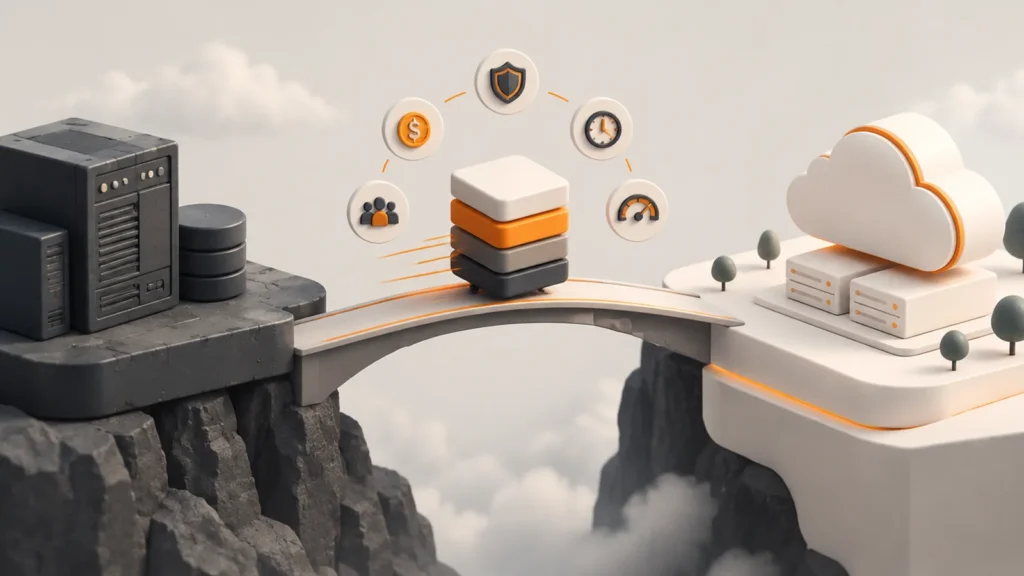
Software migration is expensive. Teams still do it because not migrating becomes more expensive—in outages, hiring, security, and lost product speed. This article lists the business triggers that justify a move, so leaders can explain “why now” without jargon.
Related: technical debt as a portfolio and migration strategy roadmap.
1. Security and compliance risk
Unsupported runtimes, unpatched frameworks, and missing audit trails fail customer security reviews. Migration is often cheaper than losing enterprise deals.
2. Talent drought on the old stack
When you cannot hire for COBOL, old PHP monoliths, or abandoned frameworks, velocity collapses. Migration is a talent strategy as much as a tech strategy.
3. Product velocity has flatlined
If a small feature takes weeks because of brittle coupling, migration (or modularization) restores shipping capacity. Measure lead time before and after.
4. Cloud / hosting economics
Data centers, over-provisioned VMs, or license cliffs force platform moves. Pair with FinOps: see cloud cost optimization.
5. Vendor lock-in or end-of-life
Paas, CMS, or ERP vendors raise prices, kill products, or change APIs. Exit paths need migration programs, not hope.
6. M&A and portfolio consolidation
Acquisitions leave duplicate CRMs, billing systems, and identity stores. Migration unifies the customer experience and reporting.
7. Scale and reliability ceilings
Single-database monoliths, session sticky servers, or batch-only integrations cannot meet SLAs. Architecture change becomes mandatory.
8. Data gravity and analytics needs
Leaders want real-time dashboards; legacy systems only offer nightly CSV dumps. Migration enables modern data pipelines.
9. Mobile / multi-channel products
APIs never designed for mobile, partners, or AI agents force a strangler rewrite of the edge—and often the core.
10. Total cost of ownership (TCO)
License + ops + incident cost exceeds a multi-year modernization budget. Build a 3-year TCO model with finance.
11. Customer experience gaps
Slow pages, offline processes, and manual workarounds show up in churn. Migration is a retention investment when tied to journeys.
12. Strategic AI and automation
You cannot safely bolt agents onto systems without APIs, events, or clean data. Migration unlocks AI product roadmaps—see our demo-to-production roadmap.
When not to migrate
- The system is stable, cheap, and rarely changed
- The “new stack” is fashion, not a measured bottleneck
- You lack product ownership and test coverage for a safe cutover
Frequently asked questions
Is migration the same as a full rewrite?
No. Prefer strangler patterns and incremental cutovers. Big-bang rewrites are high-risk exceptions.
How can Auroviq help?
We assess legacy estates, build migration roadmaps, and execute phased deliveries with measurable business outcomes.
Migrate & improve with Auroviq
Auroviq (AuroviQ) helps product and enterprise teams modernize software, migrate platforms safely, and improve delivery—serving clients in the UK, Netherlands, Singapore, and India from Ahmedabad & Bhubaneswar.
Enterprise Tech Stack Migration Checklist
Before initiating any software migration under the AuroviQ framework, technical leadership must evaluate the target architecture against operational constraints. Use this actionable checklist to validate readiness:
- Dependency Mapping: Audit all upstream and downstream API contracts, data pipelines, and third-party SaaS integrations.
- Security & Compliance Baseline: Verify that IAM policies, encryption standards (at rest and in transit), and regulatory frameworks (SOC2, GDPR) are mapped to the new environment.
- Data Integrity & Fallback Plan: Establish dual-write strategies, zero-downtime cutover windows, and an automated rollback mechanism if latency spikes breach SLAs.
- Cost-Benefit ROI Model: Calculate the TCO (Total Cost of Ownership) across a 36-month horizon, factoring in cloud egress fees, licensing shifts, and engineering hours.
Mitigating Technical Debt During Legacy Transitions
Migrations often fail when teams attempt to ‘lift and shift’ existing technical debt into modern infrastructure. AuroviQ recommends refactoring critical business logic prior to migration rather than attempting optimization post-deployment. By decoupling monolithic components into containerized microservices and modernizing data schemas incrementally, engineering organizations reduce deployment friction and ensure long-term system maintainability.
Tags
Next step
Building AI products that ship?
AuroviQ helps teams design, build, and scale reliable software and AI systems — from mobile apps to enterprise platforms.